
This video profiles men, like you, as well as our patients, who tested positive for prostate cancer.
Prostate cancer affects 1 in 8 men. You are not alone and Dr. Cavey is here for you.
Dr. Cavey is one of only a few DFW doctors who are experts in low dose rate brachytherapy.
Here, Dr. Cavey will deploy all of his expertise to give you the best possible outcome, including sexual, bowel, and bladder performance. He uses the very best of proven technology to get you back to the full life that you love.
These advanced technologies and techniques include brachytherapy, MR fusion transperineal biopsies, IMRT and SBRT.
Screening and diagnosis begin with your urologist, primary care doctor or Dr. Cavey. Then, treatment is fully managed by Dr. Cavey.
If you are a man around age 45, you should have a PSA test (yearly), and if you are a Black man, you should begin around age 40. Many men have an average risk of 1 in 8; however, Black men have a higher risk at 1 in 6.
Here are the types of screening that Dr. Cavey or your doctor may order:
Prostate cells produce an enzyme named Prostate Specific Antigen or PSA. The PSA is measured by a routine blood test that detects a protein produced solely by prostate cells. It is elevated in prostate cancer, but also in some noncancerous conditions (BPH, infection, inflammation). Elevated levels of PSA are often the first sign of prostate cancer. It is used in the diagnosis of prostate cancer, but also during follow up after treatment to determine if the cancer is gone.
If PSA test raises concerns, your doctor will likely recommend an MRI and/or biomarkers.
A multiparametric MRI can detect suspicious lesions in the prostate and aids your doctor in deciding if you need a biopsy. Biomarkers may also be requested and can identify if you are at higher risk of having prostate cancer.
If a PSA test raises concern, your doctor will recommend a biopsy. Dr. Cavey is an expert in the MR fusion Transperineal biopsies.
TRUS is the most common approach to performing a biopsy, which is performed by using an ultrasound probe in the rectum, and then samples are obtained by passing a needle through the rectal wall into the prostate.
Dr. Cavey primarily uses the MR fusion transperineal biopsy. This advanced biopsy technique improves diagnostic accuracy while concurrently reducing your risk of infection.
TRUS is the most common approach to performing a biopsy which is performed by using an ultrasound probe in the rectum, and then samples are obtained by passing a needle through the rectal wall into the prostate. This biopsy method takes samples from multiple standard sites with no specific lesion target.
Texas Radiotherapy utilizes the MR fusion transperineal biopsy which is an advanced technique for performing biopsies that is being used increasingly to improve the accuracy of diagnosing prostate cancer. Fusing real-time ultrasound images with pre-exam MRI data provides better guidance to help accurately target lesions identified on the MRI, potentially reducing the risk of missing high-grade tumors or understaging tumors during active surveillance.
In some instances, a CT, bone, or PET scan is ordered to determine whether the cancer has spread. These tests are usually only requested for patients with more aggressive disease (unfavorable intermediate or high-risk).
When Dr. Cavey assesses the optimal treatment plan for each patient, he looks at multiple data points: that data includes Gleason scores and placing a patient into a risk group to optimize an individual treatment plan.
When a biopsy confirms the presence of cancer, the Gleason score determines the level of aggressiveness of the cancer cells or the Grade. The score is comprised of the primary pattern + the secondary pattern or appearance of the cells. Each pattern is scored from 1 to 5, with 1 being least aggressive and 5 being most aggressive.
Prostate cancers are scored from 6 – 10.
Gleason 6 cancers are low grade, 7 is intermediate and 8 and above are high grade.
A patient’s risk group is more important than Stage (NCCN) for most prostate cancer experts. Risk groups are determined by PSA, clinical stage and Gleason score. Groups range from very low to very high. Below is a short summary:
Low risk – PSA < 10, Gleason 6, Clinical stage T2a or less.
Intermediate risk – PSA 10-20, Gleason 7, T2b-2c.
High risk – PSA >20, Gleason 8 and above, T3a or higher.
There are a range of treatment options for prostate cancer. Dr. Cavey looks at a complete set of data and will share that with you when he recommends a treatment plan. These options can include anything from active surveillance through brachytherapy, the gold standard in prostate cancer care and one of Dr. Cavey’s treatment specialties.
For men diagnosed with low-risk prostate cancer, treatment may not be necessary immediately and some men may never need treatment. In active surveillance, regular follow-up blood tests and possibly MRIs and biopsies may be performed to monitor for progression of your cancer. If tests show your cancer is progressing, you may opt for a prostate cancer treatment such as surgery or radiation.
Radiation therapy uses high-powered energy to kill cancer cells. Prostate cancer radiation therapy can be delivered in two ways:
Externally (External Beam Radiation Therapy – EBRT)
During external beam radiation therapy, you lie on a table while a machine moves around your body, directing high-powered X-rays to your prostate cancer. You typically undergo external beam radiation treatments five days a week (up to 9 weeks) or for 5 weeks if combined with brachytherapy. Modern day techniques include IMRT and VMAT.
Alternatively, a technique called Stereotactic Body Radiation Therapy (SBRT) or Stereotactic Ablative Radiotherapy (SABR) can be used. This involves typically 5 days of treatment over two weeks delivering much higher daily doses of radiation therapy. Many machine platforms have such capabilities including the Radixact. The Radixact offers the advantages of real-time tracking of the target and its technology can adjust the treatment on-the-fly so that the treatment is more precisely delivered and patients achieve better quality of life with this more precise treatment delivery.
For EBRT, Texas Radiotherapy utilizes both IMRT and SBRT to treat prostate cancer.
Proper targeting of the prostate is important since the prostate is shifted day-to-day by differences in fullness of the bladder and rectum. In order to account for the position changes, gold fiducial markers are placed into the prostate so that x-ray images can localize the markers and ensure accurate radiation therapy.
Internally (Brachytherapy)
Brachytherapy involves placing many rice-sized, radioactive seeds in the prostate gland under ultrasound guidance. The radioactive seeds deliver high doses of radiation to a very confined region and thus much higher doses of radiation therapy can be delivered than with any other technique. Since higher doses can be delivered with brachytherapy than with any other means, brachytherapy is the “gold standard” of radiation therapy since higher doses equate to better outcomes. For low- and favorable intermediate-risk patients, brachytherapy is typically used alone (monotherapy). For unfavorable intermediate- or high-risk patients, it is combined with external beam radiation therapy (combination therapy).
Hormone therapy or androgen deprivation therapy (ADT) is often used in combination with radiation therapy. ADT is a treatment to stop your body from producing the male hormone testosterone, which the prostate cancer cells use as “food”. ADT is commonly given as injections that typically last anywhere from 1 – 6 months or in pill form. ADT temporarily puts the prostate cancer to sleep. It also will shrink the size of the prostate and it works in conjunction with radiation therapy to improve treatment results. Side effects include fatigue, mood changes, hot flashes, weight gain, loss of libido and inability to have erections.
Surgical treatment for prostate cancer involves removing the entire prostate, the seminal vesicles and sometimes also some lymph nodes in the pelvis. There are two types of prostatectomies: open and robotic-assisted. Most are robotic assisted currently. Radical prostatectomy carries a risk of urinary incontinence and erectile dysfunction.
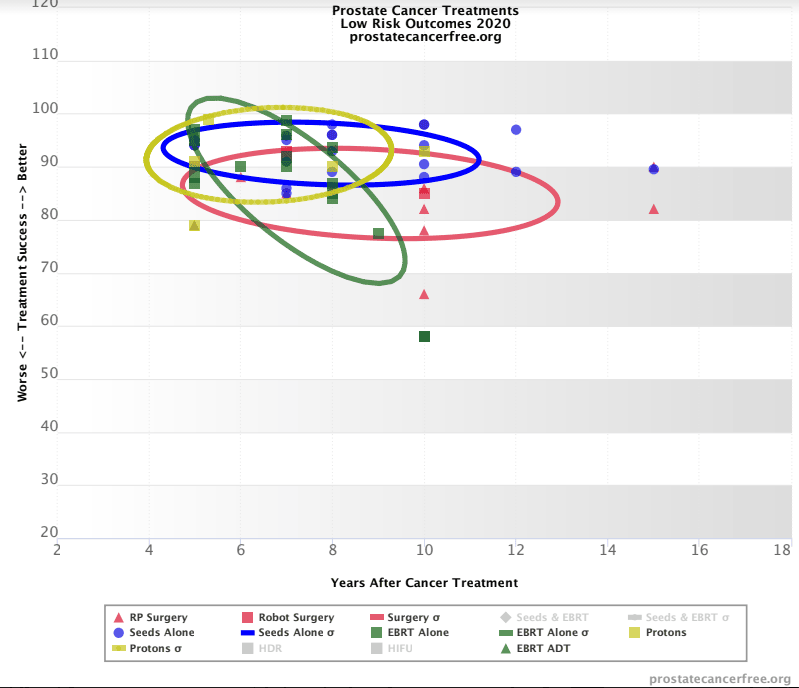
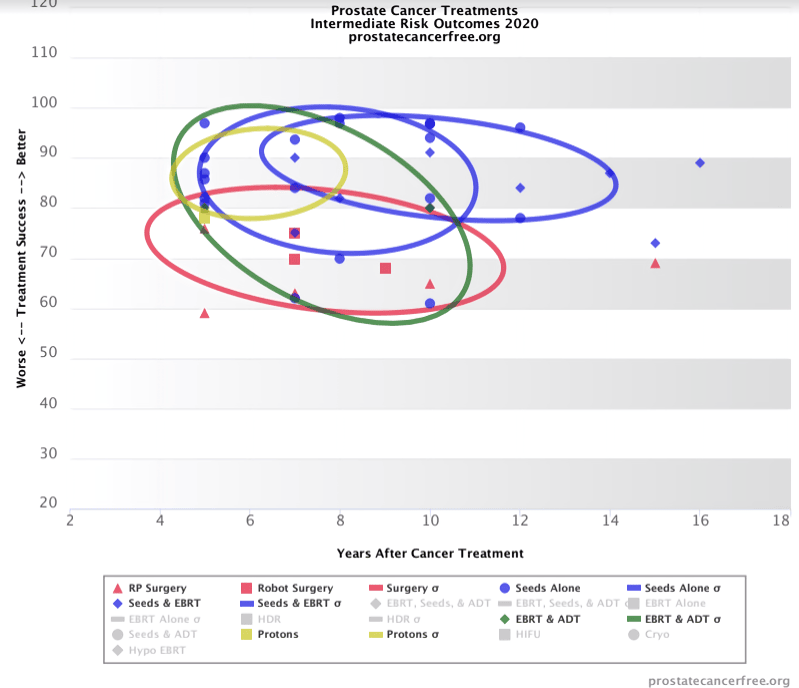
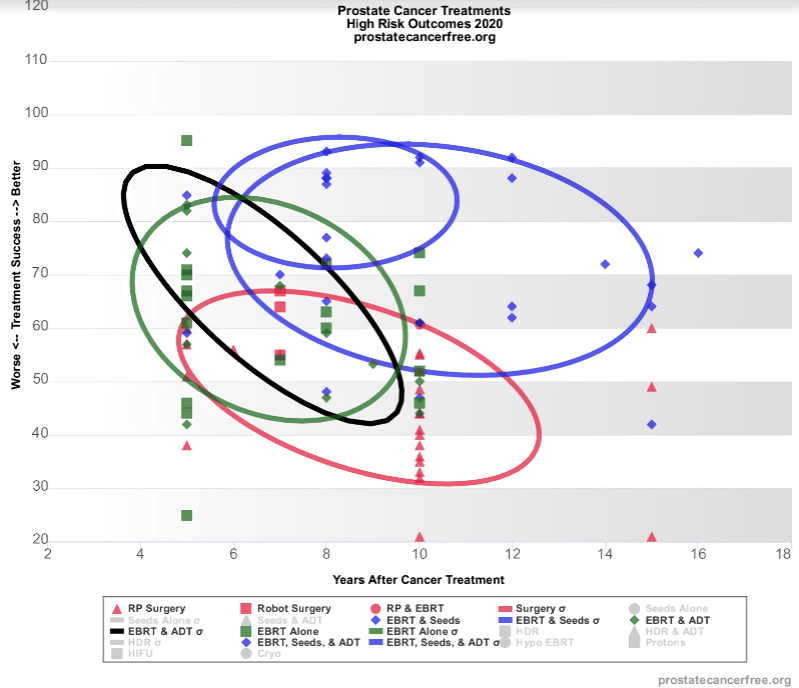
In comparison studies, low dose rate brachytherapy by itself or combined with other modalities is superior to other treatments such as external radiation or prostatectomy.
For an objective, easy to use and interactive comparison of treatment results for all treatments of localized prostate cancer by risk group, view The Prostate Cancer Results Study Group at www.prostatecancerfree.org. This is a comparison of all available studies published in the literature which are updated annually and organized by well-respected Radiation Oncologists and Urologists. The Disease-Free Survival (DFS) is analyzed by Risk Group (Low, Intermediate, and High). For each of the Risk Groups, the DFS for patients treated with Brachytherapy alone in low risk patients, or combined with External Radiation and/or Androgen Blockade for intermediate- and high-risk patients, is superior to any of the other treatments, including Radical Prostatectomy and External Radiation.
Dr. Cavey is aware that radiation therapy can create bowel problems. To reduce this risk, Dr. Cavey uses SpaceOAR by Boston Scientific – a temporary hydrogel spacer that protects the rectum from radiation exposure.
Dr. Cavey discusses his use of a product that helps maintain sexual, bladder and bowel function.
A prostate cancer diagnosis comes with crucial decisions about your treatment path, urinary and sexual function, and daily schedule. At Texas Radiotherapy, Dr. Matthew Cavey combines high-level engineering precision with personalized clinical care—bringing specialized expertise in internal seed implants, advanced radiosurgery, and organ-sparing techniques directly to every patient.
We are often asked about what prostate cancer is and how it is diagnosed. Here are answers to some of the most common questions. Below are a few essential questions men ask when evaluating radiation options with Dr. Cavey.
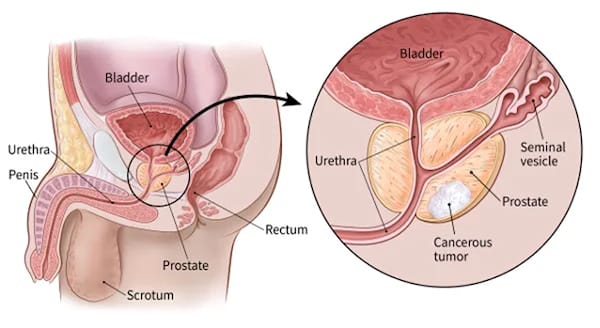
Prostate cancer is most commonly adenocarcinoma that originates in the cells of the prostate. The prostate gland is a small walnut-sized gland that is part of the male reproductive system. Typically, prostate cancer grows slowly and is often confined to the prostate gland. There are many prostate cancers that can be watched and do not require treatment. However, some cases are much more aggressive and can spread or metastasize quickly. Prostate cancer that’s detected early with screening is highly curable.
To learn more about what prostate cancer is, you can visit The American Cancer Society (https://www.cancer.org/cancer/types/prostate-cancer/about/what-is-prostate-cancer.html)
Most of the time, there are no signs or symptoms of prostate cancer. Symptoms arise when prostate cancer is discovered at an advanced stage. These symptoms can also occur with non-cancerous conditions such as benign prostatic hypertrophy (BPH) or prostatitis.
Symptoms include:
For localized and locally advanced prostate cancer, modern radiation therapy offers long-term cure rates that are superior to surgical removal (radical prostatectomy), without the risks associated with major surgery, hospital stays, or general anesthesia.
Radiation preserves the anatomical structure of the pelvis, reducing the risk of urinary incontinence. During your consultation, Dr. Cavey will review your specific PSA levels, Gleason score, and MRI imaging to determine whether external radiation, internal seeds, or a combination offers the highest likelihood of cure for your specific risk profile.
Unlike centers that rely on a single delivery method, Texas Radiotherapy offers a full spectrum of precision therapies customized to your disease:
Precision targeting and organ separation are built into every treatment plan. Dr. Cavey was the first physician in Tarrant County certified to use SpaceOAR hydrogel. This temporary, absorbable gel creates a protective cushion between the prostate and the rectum, drastically reducing radiation exposure to healthy bowel tissue. Combined with real-time image guidance and precise beam collimation, this proactive approach significantly lowers the risk of rectal bleeding, urinary urgency, and long-term erectile dysfunction.
Your schedule depends on whether you are treated with internal brachytherapy or external beams. A seed implant is an outpatient procedure where most patients resume normal light activity within days. If external radiation is recommended, advancements like SBRT can complete your curative course in just 5 visits, while hypofractionated regimens take 4 to 5 weeks rather than the conventional 9 weeks. Daily appointments take about 15 minutes, allowing men to work, exercise, and keep their usual routines with little disruption.
Yes. At Texas Radiotherapy, you are not treated like an anonymous chart. While radiation therapists assist in positioning for daily fractions, Dr. Cavey directly oversees your simulation, personally calculates and reviews your plan, and sees you regularly to manage any acute urinary or digestive changes. If questions or symptoms arise between appointments, our clinical team is directly accessible by phone or through our patient communication platform—you always have direct access to your doctor.
Discuss Your Options Directly with Dr. Cavey
No two prostate cancers are identical. Schedule an individualized consultation to review your pathology, discuss seed implants versus external radiation, and choose a curative plan designed around your quality of life.
Schedule a Prostate Consultation or call our office directly at 817-796-6400.